-
Monday Public Meetings on Digital Divide at West Potomac
The economic inequality that currently exists between groups in terms of access to, use of and knowledge of information and communication technology is often referred to as The Digital Divide. Last year, I was disturbed to learn that Fairfax County Public Schools had chosen to roll out "electronic textbooks" without ensuring that every child had the ability to use them. I first discovered they were being used when my children were at home using them. "Electronic textbooks" are a new tool in education. They are also actually more than just books. They are actually online learning system that have homework problems with real time corrections. They have extra help videos and extra homework problems. The only problem is that in order to use them you must have both a computer and a broadband connection. From knocking doors on U.S. 1, I am very aware that many of the 44th District's residents do not have a computer or enough computers and broadband connections due to income restraints. I strongly believe that no public school should use a tool that is not equally available to all children in the system, and that family income should not be a barrier to any child's learning potential.While researching this process, I discovered that both Henrico County Public Schools and Albemarle County Public Schools provide computers to every child in their system from 7th grade and up. Also, Cox Communications has just launched a program called "Internet Essentials" that provides $10/mo. broadband and $150 refurbished laptops to families that qualify for the free and reduced lunch program. However, few people know it exists yet. More information is here: Therefore, I introduced legislation prohibiting any school system from using an "electronic textbook" program unless they can show every child in their system has a computer in their home and a broadband connection. My legislation was referred to the Virginia Broadband Advisory Council and the Joint Commission on Technology and Science where it is currently being studied. However, Fairfax County has begun public hearings to take information as to how they can best close The Digital Divide in Fairfax County. The first meeting in Mt. Vernon: FCPS Digital Learning Public Hearing Monday, May 20, 2013 West Potomac High School 7:00 p.m. to 9:00 p.m. If you cannot attend, you can provide input here:
-
Will a Virginia Expungement Continue to Have Value?
In Virginia, a person is generally entitled to an expungement, if they are found not guilty or their charge is dropped without any finding of guilt. Here's what Virginia Law currently says: The General Assembly finds that arrest records can be a hindrance to an innocent citizen's ability to obtain employment, an education and to obtain credit. It further finds that the police and court records of those of its citizens who have been absolutely pardoned for crimes for which they have been unjustly convicted can also be a hindrance. This chapter is intended to protect such persons from the unwarranted damage which may occur as a result of being arrested and convicted. Once expunged, a person does not have to disclose the charge on an employment application. It is also a crime to ask someone about an expunged charge in the employment process (excluding federal security background checks). Notwithstanding Virginia Law, some companies have continued to make information regarding expunged charges available - completely destroying the purpose of Virginia's system - and continuing to subject people to the consequences of having an unfounded charge appear on their record. It's not fair at all and sidesteps Virginia Law. The Fair Credit Reporting Act currently provides some rights to consumers, but it doesn't cover everyone. Last session, I introduced very simple legislation to close a hole against people who were selling inaccurate information to the credit bureaus. § 8.01-40.3. Unauthorized sale, publication, etc., of criminal history record information Any person who sells, offers for sale, publicizes, or offers for publication the criminal history record information of another person pertaining to that other person's charge or arrest for a criminal offense more than 120 days after the State Police has confirmed to the person charged or arrested that such information has been expunged pursuant to Title 16.1 or Title 19.2 when he knows or has reason to know that the information has been expunged shall be liable to the other person for actual damages or $500, whichever is greater, in addition to reasonable attorney fees and costs. It would give Virginians a cause of action against any person who sells access to information that has been expunged from the public record. My legislation was killed after the companies that sell this information said making the information they sell to the public would be too burdensome. This 60 Minutes piece below that ran a few months ago, gives some insight as to what's going on in the industry. The tolerance within the industry for putting out bad information is astounding.
-
Mt. Vernon Snakeheads In the News!
One of the great things about living in the 44th District is living right next to the Potomac River. The 44th District was the home of "The Snakehead Invasion" in Virginia when they were first discovered in Little Hunting Creek and Dogue Creek. Since then, the Department of Game and Inland Fisheries (DGIF) has been conducting studies in our creeks to learn more about these fish and how they might impact our ecosystem. Based on what I've seen, they don't seem to live around shopping carts, bottles or cans.... Any any event, I've written about this previously below: The big question for Virginia is whether we legitimize them - take them off the invasive species list - so they can be bought and sold, served in restaurants, competitions held and citations issued? Once that happens, you will see them in every river in Virginia. They are great sporting fish and I'm told they taste pretty good. Today's Washington Post has a great video (much better than the ones I did) featuring DGIF Biologist John Odenkirk and his studies. John has become one of the preminent snakehead experts in the United States. You can see the videos I put together on the flip including my trip with Delegate David Bulova with John Odenkirk.
-
Ice Rinks Become Political in 2013
The other day, I dropped my girls off at the Mt. Vernon Ice Skating Rink for the weekly Skate Night. Skate Night is basically a bunch of 5th through 8th graders skating in circles with disco lights, music, and a bunch of parents huddled in the stands gossiping away. I've been going to this rink and the Rec Center my entire life. Skated there and played in the pool as a kid. We did infant swimming lessons there with my girls. My children have taken soccer classes and gymnastics at the Lee District Recreation Center. One night, I noticed a plaque outside the entrance to the skating rink. It said the following: In 1978, the Fairfax County Park Authority opened the region's first public indoor ice skating rink significantly enhancing opportunities for healthful activities, competition and leisure time pursuits available to Fairfax County residents. The Mount Vernon Ice Skating Rink would not have become a reality without the tireless support and effort of: Warren I. Cikins Mt. Vernon District Supervisor 1975-79 During the session, I read Ken Cuccinelli’s new book. In the book, he wrote the following:As a result of the unfair competition of the government-owned rec center, not only is the business person essentially prevented from doing business (his liberty—his opportunity to pursue happiness—curtailed), but the citizens are also harmed because everyone has to pay for the rec center through taxes, even if they never use it. - Ken Cuccinnelli, The Last Line of Defense, Page 241 This left me scratching my head. I have been talking to some of the older residents of my district who were very involved in the construction of this facility. As you can imagine, they have a different point of view. Supervisor Cikins representative to the Fairfax County Park Authority, Glen Fatzinger, was the first person to write to me. Here's what he wrote to me: As chairman of the Mount Vernon Council's Environmental Affairs and Recreation Committee and subsequently Warren Cikins' Mount Vernon appointee to the Fairfax County Park Authority, I was tasked with bringing to fruition the public's desires for an indoor ice rink in Mount Vernon. A massive citizen survey of what was desired for our Mount Vernon District Park revealed that an indoor ice rink was the number 1 priority. When I was appointed to the Park Authority, I worked very hard with the other Park Authority members and Warren Cikins as well as other members of the County Board of Supervisors to ensure that this project was completed. Contrary to Cucinnelli's comment, we searched for an entrepreneur to build and operate a public ice rink in our area but no one was interested in doing that, so we proceeded with it as a publicly-funded project with the admission charges paying for the operating expenses. Cucinnelli is simply wrong as we did not deprive any private sector person from operating such a facility--no one was interested in the project. Cucinnelli should get his facts straight! Then I heard from Supervisor Cikins himself. I've posted a history that he wrote about the center back in 1994. The arguments used to defeat it almost seem quaint. Today, thousands of people use this facility every week. It's one of the few places ice hockey teams can play given that there are only five indoor ice arenas in Northern Virginia. The Washington Capitols used it as a practice facility for a period of time. West Potomac High School has even produced an Olympic figure skater- Ashley Wagner. It's mind boggling to me that anyone could be opposed to public recreational facilities like this today. These facilities are critical pieces of our quality of life in Fairfax County.
-
Demolish Woodlawn Elementary School?
 | | Woodlawn Elementary School Today |
The Mt. Vernon-Lee part of Fairfax County has always been known for its history. The Mt. Vernon Estate is our crown jewel. The Woodlawn Mansion is a National Historic Landmark and the entire estate is subject to a historic zoning district. The Grist Mill is growing in popularity. Gunston Hall was the home of founding father George Mason. U.S. 1 was renamed "Historic Route One" by the Commonwealth of Virginia in 2010 with an amendment by Governor McDonnell to HB530 that I requested honoring Route 1 for its trove of historic assets. One other asset along the road is Woodlawn Elementary School, but it is threatened. In November, 2009, I held my first campaign kickoff in the Woodlawn Elementary School Auditorium because I thought the school symbolized several different trends in our community - history, diversity, changing demographics, and educational success. The school honors its history by educating new families about the school's long history in our community. In September, 2012, I learned that Woodlawn Elementary School is scheduled to be renovated and that as part of that, Fairfax County Public Schools' engineering staff has decided to demolish the oldest part of the school. I've been raising objections to this since then, but nothing has changed. Here's some background. Woodlawn Elementary's Beginnings  In 1846, the Quaker's of Woodlawn decided to begin educating children in the Woodlawn part of Fairfax County. The used the Woodlawn Mansion as their first school. The school shifted to the miller's cottage for George Washington's Grist Mill, then the Gray's Hill Mansion ( near the Belvoir Parade Grounds), and then the Quaker Meeting House (presently standing in Fort Belvoir). In 1869, the County decided to build a public school in the area and located it on half an acre of donated land on the Accotink Turnpike (U.S. 1). In 1917-18, the structure burned and the two-room school was rebuilt. There is a ton of other local history associated with the early schools that is covered in the document History of Woodlawn School by Mattie B. Cooper from 1968 which is online here. The New Deal Fairfax County School Modernization ProgramIn 1929, Wilbert Tucker Woodson or W.T. Woodson was appointed as FCPS Superintendent. He served until 1961. Here's what the book A History of Fairfax County says: There was little interest in public schools among the older and more influential citizens who through long Virginia tradition preferred private schools and academies. This group included the local politicians and large land owners, many of whom bitterly opposed repeated requests for increases in taxes for schools and used many means to deny them. The government workers, many being relatively new residents of the county, were interested in public schools and did not think the small rural schools offered the opportunities they felt their children should have. Because the children of government workers of the district or federal level were admitted free in the urban schools of Washington, and since public transportation on the steam and electric railways and by bus was economical and convenient for most county children, many parents sent their children to Washington schools. Thus, this group which would naturally have exerted a strong influence for improvement of the local school system in the county was solving the problem of educating their children in another way. A History of Fairfax County by Nan Netherson, Page 573.  | | Photo From Burke Patch - Taken by Tim Follos |
Woodson commenced a FCPS modernization program to "replace the pot bellied stoves, water buckets, outhouses, pumps, and open wells, with modern heating systems, running water, and indoor plumbing, along with better learning and teaching facilities." FCPS obtained a loan from the Virginia Literary Fund and a grant from the Public Works Administration (PWA) with the Federal Government. The first "new" school was Franconia Elementary in 1931 - it was demolished in 2010 as part of FCPS' renovation. The second was Groveton in 1933 - demolished in 1991 and moved to its current site. The old Groveton Elementary site is now The Beacon Apartments. Centreville and Lorton Elementaries were built in 1934. Centreville is now Mountain View Alternative School and Lorton Elementary is still standing but no longer used as a school. Fairfax High School was built in 1934 and then sold in the early 1980's. Today, it is Paul VI Catholic High School.  | | Front Door at Woodlawn Elementary | Woodlawn Elementary School was built in 1937. It is the oldest public school in the 44th District and is the oldest New Deal Era school still standing in the entire County that is used as it was originally designed - a public elementary public school.
Fairview Elementary was built in 1938 - it's original section is completely buried in new construction ( here's an aerial picture). In 1939, Mt. Vernon High School was built. In 1974, Walt Whitman Middle School was expanded and became the present Mt. Vernon High School and the 1939 building was renamed Walt Whitman Middle School. In 1983, Stephen Foster Intermediate School was renamed Walt Whitman after Fort Hunt High School was closed, and the 1939 building was deeded to the County. Today, the original 1939 building is owned by Fairfax County but leased by the Islamic Saudi Academy. Burke, Dunn Loring and the Vienna Colored School (Louise Archer) were also built in 1939. Burke Elementary is now known as Burke School and is used for special education students. Dunn Loring is a Fairfax County Administrative Center. Louise Archer Elementary is still used as an elementary school in the Town of Vienna on Nutley Street. Woodlawn's UniquenessThe original 1937 Woodlawn Elementary building was based on a design by the Virginia State Board of Education and constructed by a firm from Newport News, Virginia. It is built in the Colonial Revival style like old Mt. Vernon High School. It has many unique features. You do not see doorways like the one at the right in modern schools. It has a slate pitched roof. The tile work in the school is unique. The door hardware is unique along with the interior doors and windows (exterior windows were replaced). The original ceilings are very high - although they were covered at some point to install air conditioning and forced air heating.  The structure itself was constructed out of brick and woodframe. It is build on a crawlspace. The floors sit on wooden joists. They don't build schools like this any more. Each of the crawlspace vents has "VSBE" forged into them - Virginia State Board of Education (see picture to right). After its construction in 1937, the building saw additions in 1938, 1947, 1952, 1956, 1986, and 1987. You can see the additions in the documents I have uploaded here. Application for Historic ListingFCPS applied for listing on the Virginia State Register of Historic Places in 2012 to access tax credits as part of the renovation. You can read part of the listing here. The building barely missed listing criteria due to how the application was framed. Properties frequently need to be resubmitted for listing after feedback. In December I spoke with the Virginia Department of Historic Preservation and they said that given the school's many additions, in addition to it still utilizing the oldest structure, it is also an excellent example of FCPS' changing facility needs through the last eight decades. A local Mt. Vernon historic architect who formally chaired the Fairfax County Architecture Review Board, Richard Bierce, has offered to conduct and assessment and draft a revised application at no charge to FCPS. Where Things Stand TodayOn February 3, 2013, The Fairfax County History Commission wrote to FCPS and asked that the historic designation application be resubmitted with the ultimate goal of preserving the older part of the school and renovating with the use of federal tax credits. You can read the letter here. No response has been received. At this time, it appears that FCPS is not willing to reconsider their decision and says that the oldest part of the school must be demolished to make the building compliant with the Americans with Disabilities Act. FCPS also would like to improve the flow of cars at the school. Obviously, many historic buildings are renovated and remain intact such as The United States Capitol. The primary problem is that the older part of the school is about ten steps higher than the new part necessitating a lift or a ramp. Many people in the community I have spoken with are disappointed with this decision to demolish one of the oldest public assets in our community now that they are just starting to learn about it. I am hopeful that FCPS will reconsider its decision after hearing more from the community. I also hope that FCPS will adopt a more comprehensive strategy to protect and honor our historic assets instead of continuing to demolish our older schools. You can find more detailed information here relied up on in writing this article:
-
History of U.S. 1: Early Schools along Route One, Part 3
In 2006, the Mount Vernon Gazette ran a series of articles by local author Michael K. Bohn on the history of U.S. 1. They provide some interesting history on U.S. 1. The following was written by Michael K. Bohn and ran in the Mt. Vernon Gazette, in 2006. Early Schools along Route One, Part 3
Michael K. Bohn Mount Vernon Gazette, 2006
This is the final part of the schools segment in the Route One history series. It describes the remaining historic elementary schools and early high schools near Route One.
 | Potter’s Hill offere a few high school courses, but was primarily an elementary school. | Potter’s Hill. Telegraph and Accotink Roads (now approximately Telegraph and Beulah Roads). Built prior to1879, the school was replaced by a new structure in 1917 that offered both elementary grades as well as a few high school subjects. Not deeded to the county until 1918, Potter’s Hill burned in 1934. Snowden. Fort Hunt Road and Chadwick Avenue. Prominent local men living along the river near the Neck Road (now Fort Hunt Road) donated money for the construction of the school in 1870. They included Theron Thompson, owner of Hollin Hall, William Hunter of Cedar Hill Farm, now Waynewood, and Valentine Baker of Wellington (now River Farm/American Horticulture Society). Stacey Snowden, who owned Collingwood, donated the land. Although it burned to the ground in 1900, the community deeded the land to the county the same year. The Fairfax County erected a new building in 1903, closed it during the years 1907-11, with the students transferring to Woodlawn School. The school district added a second room in 1917, with Mildred “Aggie” Finks starting a Sunday school in the building in 1929, a congregation that later became St Luke’s Episcopal Church. The county closed Snowden in 1939, transferring the children to Groveton; the school building burned in 1941. Mrs. Finks was a long-time member of the Fairfax County School Board.
 | Gladys Bushrod, ninety-eight, is a life-long Mason Neck resident. She is a valuable source of information about the area’s history and a respected elder in the community. Michael K. Bohn | Spring Bank. Quander Road and Route One. Fairfax County opened this school for African-Americans in 1890. Little information about it survives, but a description of the school, written by a student, describes its proximity to the student’s homes. “It is about five minutes walk from our house. Although we live near the school there are some of the scholars who have a long way to go.” A movement to consolidate Spring Bank, Gum Springs, and Woodlawn schools began in the 1940s, but Spring Bank remained open almost until integration. The building was a private residence for the last few years before its demolition.
Woodlawn. 8505 Highland Lane (Engleside, just off Route One). The Quakers who bought Woodlawn Plantation in 1846 started a school the following year in the miller’s cottage at George Washington’s gristmill. Later, after the Friends built their meeting house in 1851, the students met there. Courtland Lukens, owner of Engleside Farm, and E.E. Mason, son of John Mason who purchased Woodlawn from the Quakers in 1853, donated land for a two-room school in 1869. Although the date of its transfer to the county is unknown, the school has thrived continuously for 136 years. When Snowden and Groveton schools closed 1907-11, Woodlawn families drove a wagon to pick up the children so that they could attend Woodlawn School. The school burned in 1917, but the county quickly rebuilt it on the same site. The current school opened in 1938 on land purchased from Engleside Farm. There have been multiple additions to the school since then. Over the years, Woodlawn teachers and principals have come from many of the Quaker families who were important to the vibrancy of the community—Gillingham, Lukens, Wilkinson, Cox, Buckman, and others
Woodlawn Colored. Woodlawn Road, Fort Belvoir. In 1866, freedmen started Woodlawn Methodist Church near what is now the post commissary on Fort Belvoir. The church soon opened a school, later erecting a separate building for it in 1888. Initially staffed by Quaker teachers, the first African-American began instructing the students in 1871. As Fort Belvoir expanded in 1940, the church had to move to Gum Springs, leaving its cemetery on the Army’s grounds. The county closed the school in 1940, transferring the children to Gum Springs School.
Fairfax County built most of the current elementary schools between Old Town and the Occoquan River during the great building boom of the 1950s and 60s. Officials later closed several as subsequent enrollment declined. Hollin Hall School, for example, is now a senior citizen center, while Hollin Hills School is a private retirement home.
Sadly, all of the one-room schools in the Mount Vernon area are gone. The county did save Legato School, turning it into a museum. It was open from 1870 until 1930 at its original site—now the intersection of Highway 50 and West Ox Road. The county moved the structure in 1972 to central Fairfax City on Route 123.
High Schools Manassas Industrial. 9601Wellington Road, Manassas. There was no high school for African-Americans living in Fairfax County until 1938 when Fairfax joined Prince William and Fauquier counties to purchase the Manassas Industrial Institute. Opened in 1894, the private school had trained African-American students in carpentry, blacksmithing, masonry, laundry, sewing, and other trades. The three counties transformed the facility into a regional, segregated high school. Gum Springs resident Ben Holland drove area students in a bus to Manassas starting in 1934. A segregated high school for blacks—Luther Jackson High School—opened in 1954 on Gallows Road. Prince William demolished the Manassas facility in the early 1960s after integration. In 1995, the city of Manassas dedicated a memorial to the school, and its founder, Jennie Dean.
 | Lee-Jackson High School, shown here in the 1930s, opened for Mount Vernon area students in 1926 at its first location on the south side of Duke Street at Quaker Lane. In 1939, Fairfax County moved both the student body and faculty to a new facility on Route One, later renaming it Mount Vernon High School. Prior to 1951, the strip between Duke Street and Cameron Run was in Fairfax County. Virginia Room, FCPL | Lee-Jackson. South side of Duke Street at Quaker Lane. Lee-Jackson was the first public high school available to students in the Mount Vernon area. Opened in 1926, it was located at the current Alexandria city ball fields and maintenance facilities on Duke Street. (Alexandria annexed the strip of Fairfax County between Duke Street and Cameron Run in 1951.) The county opened a new high school on Route One in 1939, transferring both the students and faculty from Lee-Jackson over the Christmas holidays. The school system later changed the name to Mount Vernon. It is the current site of the Islamic Saudi Academy. Today’s Mount Vernon High School opened in 1974.
Groveton. 2709 Popkins Lane. The county bought land from the Catholic Church in 1950, then opened Groveton High School in 1956. Twenty years later the school system built a new Groveton facility on Quander Road, with the old structure later becoming Bryant Alternative High School.
Fort Hunt. 8428 Fort Hunt Road. Opened in 1963, Fort Hunt was unique in that a large number of the students walked to school. In a controversial decision in 1985, the county merged Fort Hunt with Groveton to form West Potomac High School, using the Groveton campus. The county converted Fort Hunt to Sandburg Middle School.
In 1960, Fairfax County opened nine intermediate schools and began operating a scheme of six elementary, two middle, and four high school grades. The county added eighth grade to high schools in 1946, but credits earned in that grade did not count for high school graduation until 1961.
-
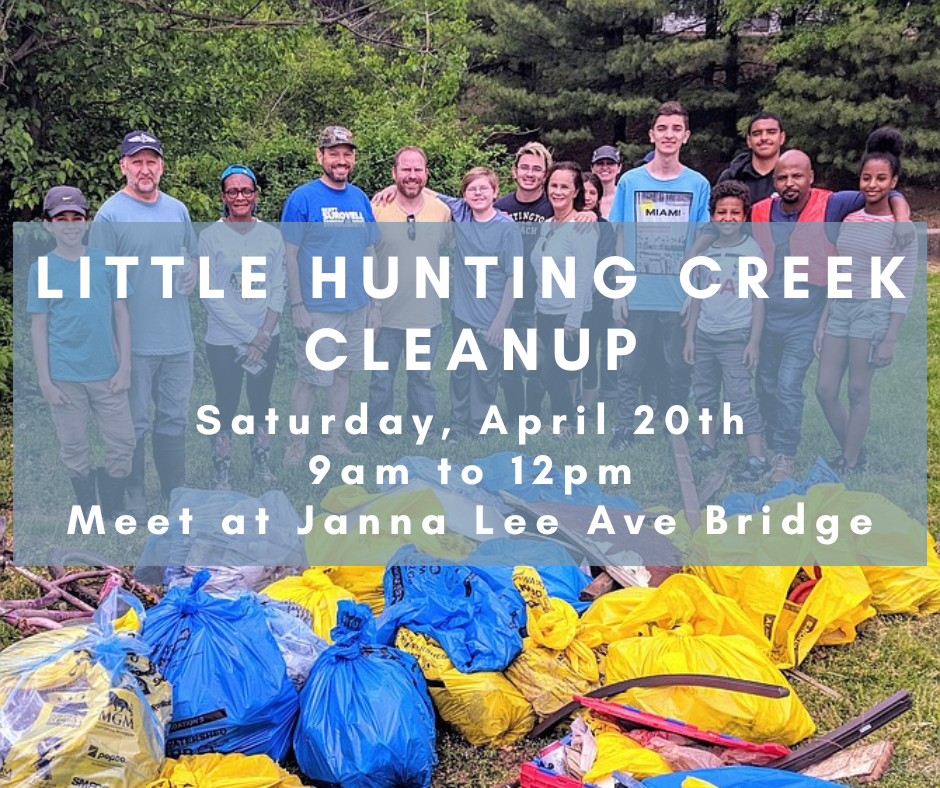
Little Hunting Creek Cleanup 2013!
RSVP NOW BELOW! Once again, we are back to Little Hunting Creek and this time we are back in force! My preliminary investigation of the creek has located at least a dozen shopping carts and thousands of bottles, cans and bags along with the usual assortment of bike and other trash. Last year we over 90 volunteers cleared the following from just 1/2 mile of creek: - 139 Shopping Carts
- 120 bags of trash
- Nearly two dozen tires
- Over a Dozen Bikes
- A Tractor Tire, Mattress, Barbells, stereos, paint cans, car bumpers, statues, picnic tables, animal houses, chairs, wheelbarrows, DVD's, vacuums, tools
- Thousands of pieces of styrofoam and plastic food containers, plastic bags and beverage containers
I even made a video you can watch here: This year we are expanding to three different locations between Fordson Road and the Janna Lee Bridge - basically behind most of Hybla Valley's retail areas. Please join us at one of the following locations:- Janna Lee Ave Bridge: From Route 1, turn west on Buckman Rd, Right on Janna Lee Ave., to the bridge over little Hunting Creek (just before the Creekside Village Apartments) (Click here for Janna Lee Location)
- Creekside Village Location: Take Janna Lee Avenue all the way through Creekside Village Apartments, until terminates at the end of the parking lot (Click here for Creekside Villeage Location)
- At Mount Vernon Shopping Plaza: Meet on Fordson Rd., beside the Duron Store at the northeast corner of Mount Vernon Plaza. Parking is available behind Shopper's Food Warehouse and the post office, or on Cyrene Drive in South Meadows Condos. DO NOT park in the limited parking in front of Duron and neighboring stores. Be sure to wear rubber boots- the easiest access is to walk in the channel. (Click Here for Mt. Vernon Plaza/South Meadows Location)
Young kids love to pick up the trash and it's a great way to raise awareness among children. Boy Scouts, Girl Scouts and any other group is more than welcome to join us. If you are interested in attending RSVP below so we can bring enough supplies. Loading...
-
An Institution Hangs Up His Quill
Yesterday, we learned that Delegate Lacey Putney is calling it quits after 52 years in the House of Delegates at the age of 84. Lacey won his first election in 1961 at age 33 when John F. Kennedy was President. He was elected as a Democrat, but changed his party affiliation to Independent in 1968. He has caucused with the Republicans starting in the late 1990's and briefly served as Speaker. Lacey is an a trial lawyer who hails from Bedford County - right across the Roanoke River from my grandfather's homeplace in Franklin County. Every time he speaks, I have flashbacks to my summers spent in Franklin County and my grandparents friends who I met through the years. People just don't talk like Lacey any more. He has seen a lot in his 52 years in the House and I always found my conversations with him in the Member's lounge to be fascinating. When you have 52 years of experience, you have a lot of wisdom and insight to offer about Virginia, legislating, practicing law, or million other things. Managing a process where $80+ billion gets divided up by 140 people who want a piece of it for their district and where it must be balanced after 60 days requires a lot of skill, judgment, and people skills. Lacey has been in charge of that process for about the last 10 years including the first cycle when I was elected where we saw the worst budget crisis in 70 years. He pulled it off repeatedly without a mutiny. Most of us who were there, will never forget the day he took the podium with his Washington & Lee Law School classmate (and 44th District resident), former U.S. Senator John Warner. You felt like history was standing there before you. One day, I was before a Finance Committee Subcommittee waiting for one of my bills to be killed and Lacey went ahead of me (that's the custom for Committee Chairmen). He was presenting a bill to propose a referendum to increase the the sales tax - half to pay for roads and half the fund the General Fund. He went into stories about how the condition of the roads in his district had deteriorated to the point where he thought they presented safety issues, and he talked about how there simply was not enough money in the General Fund to pay for our responsibilities such as schools, colleges, public safety, healthcare, and the safety net. When Lacey stands up on the floor to speak, people listen. I was awestruck that the Chairman of the Appropriations Committee was in there pushing a possible tax increase, but to me it spoke volumes about how dire our revenue situation has become - on both transportation and the General Fund. It says a lot about how the General Assembly has changed over the last 40 years. Lacey has been an institution and his presence at the chair next to the entrance will be missed by all of us who serve with him. The loss of 52 years of experience and the wisdom that comes with it is something that will definitely be felt in our Chamber.
-
History of U.S. 1: Early Schools Along Route One, Part II
In 2006, the Mount Vernon Gazette ran a series of articles by local author Michael K. Bohn on the history of U.S. 1. They provide some interesting history on U.S. 1. Part I can be be found here: The following was written by Michael K. Bohn and ran in the Mt. Vernon Gazette, in 2006. Early Schools along Route One, Part 2
Michael K. Bohn Mount Vernon Gazette, 2006
This is the second of a three-part schools segment in the Route One history series. The first reviewed the development of education in Fairfax County from colonial times through desegregation in the 1960s, and described elementary schools at Accotink, Cameron, Colchester, Groveton and Gum Springs. This section addresses five historic schools in the Mason Neck area. The third and final schools article will survey the remaining historic elementary schools along Route One, as well as area high schools.
 | Gunston School was open to Mason Neck white students from the late 1870s to the late 1890s. Shiloh Baptist Church bought the facility in 1900 and converted the schoolhouse into their first chapel, the white section of the church on the right. Michael K. Bohn | Gunston. 10704 Gunston Road. Jophn Haislip, a member of a prominent Mason Neck family, gave an acre of land in 1878 for the construction of a log schoolhouse. The school was not operating in 1900 when Shiloh Baptist Church bought the schoolhouse for use as their chapel. The church still uses the original structure; it is the white framed section on the north side. The current Gunston School opened a few miles north in 1955.
Gunston Colored School. Gunston Road, across from Shiloh Baptist Church. In 1882, Fairfax County bought one acre of land from Edward Daniels, then the owner of Gunston Hall. The county built a small school across the road from the Gunston white school and opened a segregated facility. In 1914, Gladys Bushrod, now ninety-eight and a life-time resident of Mason Neck, enrolled at the school when she five. “During the holidays, Mrs. Hertle, whose husband bought Gunston Hall from Daniels, invited all of us kids to her house,” recalled Mrs. Bushrod recently. “On Halloween, we bobbed for apples, and at Christmas, she gave us presents and hot chocolate.” Mrs. Bushrod finished the eighth grade at Gunston, and since there was no was no high school available to her, that was the end of her education. The county closed the school in early 1930s and the African-American families living in Mason Neck had to send their kids to Woodlawn School, fifteen miles away. Parents petitioned the school board for reimbursement for bus fees, a request that was usually granted. The county transferred the land back to Gunston Hall in 1954. (Note: Fairfax County Public Schools used the term “colored” to refer to African-Americans in all official documents until the 1960s.)
Lebanon. 10310 Gunston Road. John Haislip also donated land for this school, located on Gunston Road, across and just south of the entrance to Pohick Bay golf course. The school opened in 1899, and the families named it for the Lebanon farm that is now the golf course. The county closed the school and sold the building in 1935. The Vosburg family bought it in 1938 and lived there until 1946 when they demolished the structure and reused the lumber for a new home. Gladys Bushrod said that the owners demolished the most recent house a few years ago, probably in 2000. Earl Curtis, chief of the Lorton Volunteer Fire Department and long-time school bus driver on Mason Neck, said that he attended Lebanon School 1931-34, transferring to Lorton Valley School when Lebanon closed.
 | Area residents opened Lorton Valley School in 1876 on land donated by John Plaskett, then added a second room in 1881. Fairfax County operated the school for about thirty years before selling it in 1926. The purchaser converted the building into a residence, and pictured here in 1970 is a subsequent owner, Percy Ruffner. Virginia Room, FCPL. | Lewis Chapel, Lorton Valley. 9723 Gunston Cove Road. Four Mason Neck men—Joseph Wiley, Richard Trice, John Haislip, and John Reardon—sponsored a log school near the current intersection of Old Colchester Road and Hassett Street in the 1840s on old field land donated by the McIntosh family. It was probably the first schoolhouse in the Mount Vernon area. A few years later, perhaps in the late 1850s, the community school relocated the school to the site of Lewis Chapel, a Methodist church built in 1857. Now called Cranford Church, it is located at the intersection of Old Colchester and Gunston Roads. That schoolhouse burned in 1876 and the community again opened another on land donated by John Plaskett. Called Lorton Valley, it was located at 9723 Gunston Cove Road. The school added a second room in 1881, with grades one-four studying the Three R’s in one room, and grades five-eight learning geography, history, hygiene, and reading in the other. In 1905, the school’s lead teacher, George A. Malcolm, who was also a Fairfax County deputy sheriff, was mortally wounded by a man who worked at the nearby Lorton railroad station. The assailant had been harassing girls at the school, and shot Malcolm when the deputy went to the station to arrest him. The county sold the building in 1926. By 1933, the owner converted the school into a residence, with Percy Ruffner, a guard at the DC Reformatory, buying it in 1939 for $2,500. (Ruffner’s great uncle, William H. Ruffner was the first superintendent of public schools in Virginia.) Percy, his wife, and three children, one of whom is still a Mason Neck resident, Sally Spangler, lived in the old school until the 1980s. “One of the classrooms had been made into a living room and dining room, with the second classroom becoming three bedrooms,” Mrs. Spangler explained recently. “The ledges for the chalk were still there.” The building collapsed in the 1990s—“The termites got it,” said Mrs. Spangler—and the land is now owned by a developer.
Lorton. 8101 Lorton Road. The date Lorton School opened is unknown, but for years, it was housed on the second floor of Springman’s store, adjacent to the Lorton railroad station. Today, that should be about where Lorton Road intersects Interstate 95. The county built a two-room schoolhouse in 1923, then a larger, brick structure in 1934. The school system transferred all Lorton students who lived east of Route One to the new Gunston School when it opened in 1955. The county converted Lorton into an administrative center in 1989. Nearby Lorton Station School opened just a few years ago.
-
History of U.S. 1: Early Schools on U.S. 1, Part I
In 2006, the Mount Vernon Gazette ran a series of articles by local author Michael K. Bohn on the history of U.S. 1. They provide some interesting history on U.S. 1. The following was written by Michael K. Bohn and ran in the Mt. Vernon Gazette, in 2006. Early Schools along Route One, Part 1 Michael K. Bohn Mount Vernon Gazette, 2006
This is another segment in the continuing series about the history of Route One in the Mount Vernon area.
Route One, and its predecessor, the Potomac Path, has been at the center of economic, residential, and religious development in southeast Fairfax County for hundreds of years. Just as settlers built their homes and churches along the road, they created schools near the route for their children. The population was sparse enough until the middle of the 20th century that transportation to and from school drove the selection of school sites.
Today, Fairfax County boasts the twelfth largest public school enrollment in the U.S., and the system enjoys a national reputation for excellence in education. We are proud of our area’s schools, but at least in the Mount Vernon area, there was little to praise until the post-World War II building boom. As late as the 1930s, one-room schools houses were the order of the day, and there was no high school in the Mount Vernon supervisory district until 1926. Moreover, the development of public education in Virginia as a whole was typical of the south, a region that lagged considerably behind the pace set by states in the Northeast. The educational resources and facilities that we now take for granted are a relatively recent phenomenon.
This section of the Route One history series surveys the creation and growth of schools along the corridor. It will appear in three parts.
The Early Social Context While some colonies in the America were born of religious intolerance within England, the commercial basis of the Jamestown colony ensured continuing ties to London. The plantation class in Virginia also reflected the social and economic standards of the corresponding society in Britain. As the colony prospered, the growing elite espoused the same value set in the new world, one that dominated colonial life, including the direction of primary and secondary education. These men’s attitudes toward education reflected the traditional English approach—parents were responsible for educating their children. Planters usually either hired local tutors or sent the children back to England for an education.
Racial distinctions and demographics also drove the educational process. During the mid-1700s, slaves and indentured servants constituted about half of the colony’s population. Education was generally not available for them. Plus, residents were widely dispersed and there were few towns, depriving most areas of the population density required to support a school.
Some Church of England parishes in Virginia provided schools, either private instruction for the wealthy or schools for paupers. Virginia banned the church after the Revolutionary War and that ended the “parson’s schools,” as two-thirds of the ministers retired or left for England.
A 1796 Virginia law regarding public education made it optional for counties and left responsibility for funding and administration of schools to those jurisdictions. Little progress was made, but a few individuals helped with private funds. George Washington, for example, donated money in 1785 for the creation of the Alexandria Academy, a school serving orphan children. In his 1799 will, Washington also left shares in the Bank of Alexandria to the school as an endowment. Additionally, Virginia established the Literary Fund in 1810 and the commonwealth distributed some resources to schools for the poor. Most of the money was directed at teacher wages, rather than construction of school buildings.
Virginia’s General Assembly passed another law in 1829 that authorized counties to establish free schools. The lingering planter class, however, and the county court house form of government that the wealthy controlled, generally did not initiate any educational program involving increased taxes. By 1846, only six of Virginia’s 110 counties supported public schools.
Private academies provided educational opportunities to the growing middle class between the Revolution and the Civil War. Benjamin Hallowell’s school in Alexandria is an example. He lived and conducted the school in what was later called the Lloyd House, home of the Alexandria Library’s local history collections until the city moved it to the Barrett branch on Queen Street. Episcopal High School, also in Alexandria, opened in 1839.
Long after they disappeared in the Northeast, academies flourished in the South, especially during the forty-year economic depression that followed the Civil War. But woefully inadequate funding hindered any large scale success—the annual average per capita expenditure on education in the U.S. at the time was $2.80, but only $0.90 in the South.
Literary Fund records from 1828 indicate that there were twenty-six schools operating in Fairfax County, but there is no data about whether they were public or private, or their location. Historians suggest that most were one-room schools supported by local families who built log or crudely framed structures and paid the teachers. Susan Annie Plaskett, described such a school in her 1936 book Memories of a Plain Family. It was on Old Colchester Road (the original Potomac Path) and her grandmother, Mary Jane Cranford, enrolled there in the 1840s.
Residents called these facilities “old field” schools because landowners donated an acre or two of a spent, infertile portion of their farms for school construction
Fairfax County Schools Fairfax Country created twenty-two school districts in 1845, stipulating that each district construct school facilities within walking distance of all students. The Civil War and Reconstruction slowed the advance of public schools in the county, so little was achieved until the state took the lead.
Despite earlier fits and starts, Virginia public schools date to a new commonwealth constitution adopted in 1869, and the subsequent establishment of a state-wide school system. In 1870, the year Virginia was readmitted to the Union, there were forty-one schoolhouses in Fairfax County, all but one having just one room. Only sixteen had outhouses, twenty-eight were for white children, thirteen for African-American. The average school term was five months, and operating finances came from the Literary Fund, poll and property taxes, and county funds voted by the citizens. During the remaining thirty years of the 19th century, Fairfax County began acquiring the one-room schools, with the families who owned the land deeding it to the county. The number and location of the buildings reflected the fact that most of the children walked to school. By the 1920s and 30s, the county began to close the one-rooms and consolidate the students in larger, more substantial buildings that housed separate grades. Fairfax County operated its first school bus in 1924 and soon there were enough to transport the students to centrally located schools.
The first Fairfax County high school opened in 1907, eighty-six years after the first public high school in Boston. Although the Potter’s Hill School on Telegraph Road near Accotink Road offered one or two high school grades in 1917, the first fully accredited high school in the Mount Vernon area opened in 1926. The availability of high schools in the District and Alexandria slowed the growth of secondary education in the area. To partially offset this trend, the county gave money to Lee and Mount Vernon district families to pay for enrollment of their children in Alexandria schools.
By 1935, all of the one-room schools were closed, but the inequities between the segregated white and black schools were deplorable. At that time, all white schools had running water and indoor toilets; black schools had only outdoor privies. The whites had heated buses; blacks did not. White schools got ninety-seven per cent of the money. Virginia politicians resisted desegregation of the school system in the 1950s, but the process commenced after a 1959 Virginia Supreme Court decision. Fairfax County was among the first school systems certified to be in compliance with the 1964 U.S. Civil Rights Act.
If Fairfax County schools were disrupted by social upheaval of integration, then the system was staggered by explosive growth after World War II. In 1940, there were thirty-nine elementary and four high schools hosting 6,899 students, but by 1970, there 130,157 children attending 158 schools.
Schools of the Potomac Path Information about the first generation of schools along Route One is sparse. The current schools proudly maintain records of their history, but there are few details regarding antecedent schools, even of the same name. Most of the following was drawn from files at the Virginia Room of the Fairfax County Library, a few key books, microfilm copies of the now-defunct Fairfax Herald, community and church records, and interviews. If readers have amplifying information, please send it to the Gazette. Elementary and One-Room Schools School started in a one-room schoolhouse at 9:00 AM and ended at 3:00 PM. The lunch break was one hour and the students ate from the bags or pails they brought from home. They drank from a communal bucket that the older boys filled with water from the well. There were often two outhouses—boy’s and girl’s. A cast iron stove heated the structure in the winter. The boys sat on one side of the room, the girls on the other, and the teacher presided from a desk in front. Teaching twenty to thirty children ranging in age from five to twenty was a challenge exceeded only by keeping order.
 | Accotink School, shown here in 1907, was located next to Accotink Methodist Church on Backlick Road, one block north of Route One. Virginia Room, FCPL. | Accotink. Backlick Road, Fort Belvoir. One of the few with a surviving photograph, the school opened prior to 1879, and the Accotink Methodist Church briefly hosted the school on its since-removed second floor. Local families erected a separate, two-room building for the school a few years later and there is record of the deed transfer to the county in 1884. It was ordered sold in 1925 at the beginning of the county-wide consolidation of small schoolhouses. Students likely transferred to Potter’s Hill after Accotink’s closing. A private home now sits on the old school grounds.
Cameron. (Also Valley or Pulman’s School). Telegraph Road, near Franconia Road. This school served the families of “Happy Valley” from at least the 1870s. One of the most prominent was the Pulman family, members of which owned Mount Erin on the bluff above Cameron Run. The Frobel family donated the land for the school was donated by the Frobel family, and their nearby manor was named Wilton. Fairfax County acquired the facility in 1892 and sold it in 1935. No trace of the building remains.
Colchester. Furnace Road, north of Colchester. No longer standing, the school was one of two remaining one-roomers left in the county in 1932; the other was Pohick School (also called Sydenstricker), located on Rolling Road. There is very little information on the school, which the community built sometime after 1880. There was only one mention of the school in the Fairfax Herald, a brief reference in 1925.
 | This was the second of three Groveton school buildings. Fairfax County built this one in 1925 and it was used until a larger, consolidated elementary school opened in 1933. Virginia Room, FCPL. | Groveton. Route One and Groveton Street. Local families built a one-room school on the east side of Route One at the current Popkins Lane intersection in 1876. It was of frame construction, and had a stove and an outdoor privy. Deeded to the county in 1878, the school closed during the period 1907-11 due to low enrollment. The students transferred to Woodlawn School during those years. In 1924, the county bought two acres from the Reid family on the west side of Route One between Memorial and Groveton Street, building a two-room schoolhouse that opened in 1925. By 1931, the enrollment had surged to one hundred students, who were jammed into the two rooms with only two teachers. A new and larger brick building opened in 1933, one that was closed in the 1970s and demolished in the 1980s. The site is slated for a mixed-use redevelopment named The Heights at Groveton.
 | Gum Springs School, built in 1867, later became the Open House Café during the 1940s and 50s. Life on the Color Line, Gregory H. Williams. | Gum Springs. Bethlehem Baptist Church, which began in 1863, started a school for African-American children two years later. At first, the church hosted the classes, but in 1867, local men built a permanent structure using materials donated by the Freedman’s Bureau. It was located on land donated by Jane Ford Rogers just south of the intersection of Sherwood Hall Lane and Route One. In the 1930s, the county sold the schoolhouse and opened a new one on Route One, immediately south of Sherwood Hall Lane. The old building became the Open House Café, a tavern owned and operated by Tony Williams from 1947 to 1953. The site later hosted Ernie’s Crab House for years. The school closed in 1953 upon the opening of Drew-Smith School, a segregated facility. Drew-Smith closed in 1964 when the school system integrated and the building has since been incorporated into the Gum Springs Community Center. The Gum Springs Historical Society is collocated with the Community Center.
The second and third parts of this segment of the Route One history series will follow in future issues of the newspaper.
|